What you will learn
Design a comparison that separates an observed score difference from a credible advantage claim.
Before you begin: Learning by turning a knob
Start with a question small enough to test
“Is quantum machine learning better?” is too broad to guide an experiment. A more useful question is whether a particular representation improves a particular prediction problem under stated resource limits. Write that question before running anything. Decide which data are available, what counts as success, and which mistakes matter. Otherwise it is very easy to turn a collection of attractive plots into a story the experiment never actually tested.
Give the ordinary approach a fair chance
Compare against a reasonable classical model, not a deliberately weak one. Use the same data split, handle preprocessing consistently, and give each approach an appropriate tuning budget. Keep the final test set away from those choices. For a kernel experiment, a simple classical kernel is often an informative comparator. If both methods perform similarly, that is still useful: it tells you that the extra machinery has not yet earned its place for this setup.
Count the work around the circuit
A circuit execution is only part of the pipeline. Data preparation, repeated shots, optimisation, communication and classical postprocessing all consume resources. Record the boundary of any timing or energy measurement. Also keep simulated results separate from hardware measurements. An exact simulator is excellent for debugging, but a result obtained there is not automatically a result obtained on a noisy physical device. The distinction should be visible in the caption, not buried later.
Make room for an ordinary outcome
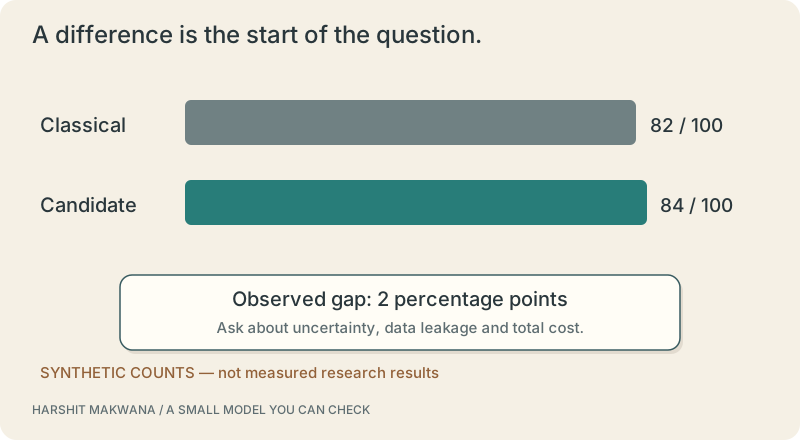
If one model gets 84 out of 100 examples right and another gets 82, you have observed a two-percentage-point difference. You have not yet established that the effect will repeat. Look at repeated runs, paired errors and the uncertainty appropriate to your evaluation. My aim here is to give you a way to ask better questions. An experiment that teaches you where an idea fails is more valuable than a claim you cannot reproduce.
SEE THE RELATIONSHIPS
From structure to behavior.
MAKE THE IDEA PRECISE
The mathematics.
| Symbol | Meaning |
|---|---|
| p_quantum, p_classical | Measured success proportions on the same evaluation set |
| Percentage points | An absolute difference between percentages |
Build the equation, step by step
- Convert the correct counts into proportions using the same denominator.
- Subtract the classical proportion from the candidate proportion, then multiply by 100.
- Interpret the number as an observed effect. It contains no uncertainty estimate by itself and says nothing about unmeasured costs.
WORK THROUGH THE NUMBERS
Worked example
For 84 correct predictions versus 82 on the same 100 examples, the observed difference is 2 percentage points. To analyse paired correctness properly, you would also need to know which examples each system got wrong.
A small Python experiment.
Python 3 · Standard library only · Synthetic educational example. Run this in your own notebook or a local file.
candidate, baseline, total = 84, 82, 100
difference = 100*(candidate/total-baseline/total)
print(f"observed difference = {difference:.1f} percentage points")
Expected output
observed difference = 2.0 percentage points
Change one quantity, predict the result, and then run the code again. Explain any difference before adding complexity.
Test your understanding.
Try it: Write an experiment card with your hypothesis, baseline, data split, metric, resource boundary and one result that would count against your hypothesis.
Self-check: Would a two-point improvement prove quantum advantage?
No. You would need a precise advantage claim, suitable comparisons, uncertainty analysis and the relevant resource accounting. A small observed accuracy difference on one task does not by itself establish computational speedup, general superiority or a mechanism unique to quantum hardware.
Where this model stops: The counts are synthetic teaching values, not measured results. No quantum hardware or cloud service is invoked by this book.
A research question: Keep one assumption fixed and change another. What observation would make you revise your explanation?
Record evidence in your mastery worksheet →Read with the original sources.
These readings support the concepts and deeper investigation. The worked numbers and illustrations above are teaching examples.
Primary source / official teaching material
IBM Quantum Learning — Quantum kernel methods ↗
Feature-state overlaps and their role in a classical kernel-learning workflow.
Primary source / official teaching material
IBM Quantum Learning — Data encoding ↗
Different encodings make different assumptions about data preparation and useful structure.