What you will learn
Evaluate every proposed connection with evidence, limitations, counterarguments, and a falsifiable experiment.
Before you begin: Cognitive architectures
Turn an analogy into a test
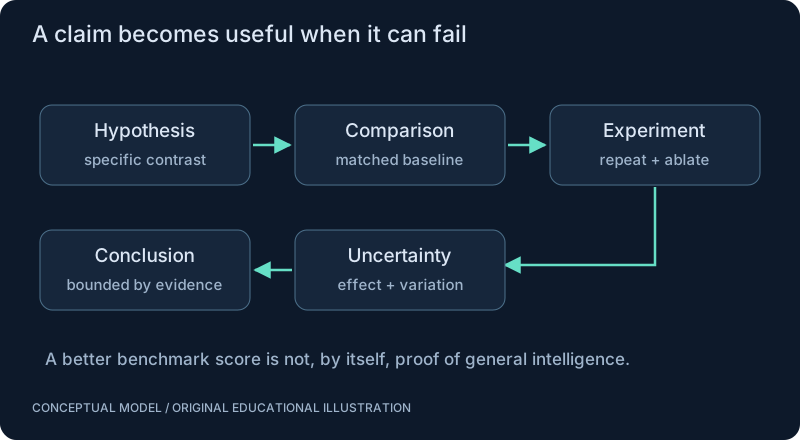
Biological systems motivate questions about sparse computation, embodiment, continual learning and memory. A useful research hypothesis identifies a measurable task and a comparison. For example: a structural prior might reduce training samples on a specified sensorimotor benchmark. This is a hypothesis until the proposed comparison supplies evidence.
Keep the claim inside the evidence
A model performing well on one task does not establish general intelligence, consciousness or a universal learning principle. Copying connectivity leaves out development, physiology, body, environment and many learning processes. Even reproducing a particular animal behavior would not, by itself, resolve broader questions about intelligence.
Neural-network perspective
Ask whether the biological idea changes the representation, architecture, learning rule, resource use or training data. Then control the alternatives. A gain from more parameters, privileged inputs or a larger compute budget should not be credited to a connectome prior. Report counterarguments and disconfirming outcomes as carefully as improvements.
SEE THE RELATIONSHIPS
From structure to behavior.
MAKE THE IDEA PRECISE
The mathematics.
| Symbol | Meaning |
|---|---|
| p_candidate, p_baseline | Measured success fractions under matched evaluation conditions |
| difference_pp | Difference in percentage points, not relative percent improvement |
Build the equation, step by step
- Express both success rates as proportions on the same evaluation protocol, then subtract baseline from candidate.
- Multiply by 100 to report a percentage-point difference. This differs from relative percentage change, which divides the difference by the baseline.
- An observed difference needs sample sizes, uncertainty, distribution details and a valid comparison. One metric improvement does not establish general intelligence or identify the mechanism that caused it.
WORK THROUGH THE NUMBERS
Worked example
Success fractions 0.80 and 0.75 differ by 5 percentage points. Without sample counts, uncertainty and comparable conditions, this arithmetic alone does not establish a reliable advantage. It says nothing about AGI.
A small Python experiment.
Python 3 · Standard library only · Synthetic educational example. Run this in your own notebook or a local file.
candidate, baseline = 0.80, 0.75
print(f"difference = {100*(candidate-baseline):.1f} percentage points")
Expected output
difference = 5.0 percentage points
Change one quantity, predict the result, and then run the code again. Explain any difference before adding complexity.
Test your understanding.
Try it: Write an alternative explanation for a five-point advantage and a control that could test it.
Self-check: What is the difference between improving from 50% to 55% and improving by 5%?
The first is a gain of 5 percentage points and a relative gain of 10%. A 5% relative gain from 50% would produce 52.5%. Report both the metric definition and denominator to avoid ambiguous claims.
Where this model stops: The book presents no proven route from connectomes or SNNs to AGI.
A research question: What result would cause you to reject your preferred architecture hypothesis?
Record evidence in your mastery worksheet →THE NEXT LAYER
Chapter depth map.
This introduction provides a first model. The following chapters are outlines for deeper future editions; their full treatments have not yet been published.
Candidate lessons
21.1 Learning and embodiment · Outline
- 21.1.1 Sensorimotor grounding and embodiment
- 21.1.2 Continual and developmental learning
- 21.1.3 Plasticity, local learning and consolidation
- 21.1.4 Multi-timescale adaptation
- 21.1.5 Why task-specific success does not establish general intelligence
21.2 Computation and integration · Outline
- 21.2.1 Energy efficiency and sparse computation
- 21.2.2 Modularity and specialized circuits
- 21.2.3 Hierarchical control and global integration
- 21.2.4 Predictive processing and world models
- 21.2.5 Architecture versus training and environment
A claim-by-claim research discipline
21.3 Evaluate an AGI hypothesis · Outline
- 21.3.1 Label established fact, practice, research, hypothesis or speculation
- 21.3.2 State supporting evidence and its scope
- 21.3.3 Identify current limitations and counterarguments
- 21.3.4 Design tests and disconfirming outcomes
- 21.3.5 Separate operational capability from consciousness claims
21.4 Limits of copying biology · Outline
- 21.4.1 Connectomes omit dynamics, history and bodily context
- 21.4.2 Structural similarity does not prove functional equivalence
- 21.4.3 Biological mechanisms may not be optimal for silicon
- 21.4.4 Compare conventional baselines fairly
- 21.4.5 Unsupported AGI claims remain unsupported
Read with the original sources.
These readings support the concepts and deeper investigation. The worked numbers and illustrations above are teaching examples.
Primary paper
Shiu et al. (2024): a Drosophila computational brain model ↗
A connectome-based computational model of sensorimotor processing. Separate experimentally tested predictions from the model assumptions and untested behaviors.
Official dataset resource
FlyWire — official project and dataset resources ↗
An adult female fly brain resource. Record the exact release and annotation version; a brain dataset should not be described as a complete brain-and-body model.