What you will learn
Design a modular architecture with explicit state, interfaces, and a task-based evaluation plan.
Before you begin: Hybrid Physical AI; Memory: biological & artificial; World models & prediction; Collective & swarm intelligence
Name functions before assigning intelligence
Perception, memory, attention, prediction, planning and motor control are useful functional descriptions. A software component named memory or reasoning does not automatically reproduce a biological mechanism. Describe the actual data structures, transformations and observable behavior rather than attributing human-like internal experience.
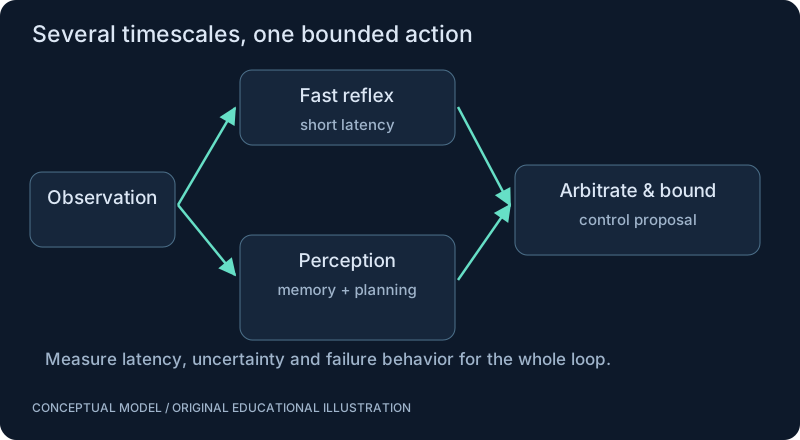
Choose how components cooperate
Modules can share state, exchange messages or propose actions to an arbiter. Every choice creates failure modes: inconsistent world state, stale plans, priority inversion or duplicated work. Self-monitoring can mean explicit checks on confidence, resource use and task progress; it need not imply a conscious self.
Neural-network perspective
An architecture may mix learned networks and conventional algorithms. The benefit of modularity is that each component can be evaluated or replaced. The toy scoring example below merely selects the highest-scoring proposal. Real arbitration needs explicit safety constraints, uncertainty handling and temporal logic beyond a maximum function.
SEE THE RELATIONSHIPS
From structure to behavior.
MAKE THE IDEA PRECISE
The mathematics.
| Symbol | Meaning |
|---|---|
| j | Index of a candidate proposal |
| score_j | Task-specific score under a stated evaluation rule |
| argmax | Index of a maximum-scoring element |
Build the equation, step by step
- List candidate actions that are currently permitted. Scores across candidates need a comparable meaning or a defined arbitration policy.
- Choose the largest score using argmax. Resolve ties explicitly if reproducibility or fairness among choices matters.
- Check the selected action against constraints before execution and monitor its result. A score is a proposal-ranking device, not a proof of correctness or a model of consciousness.
WORK THROUGH THE NUMBERS
Worked example
Three proposals have scores 0.2, 0.8 and 0.5. Selecting the second proposal follows the scoring rule; it does not demonstrate understanding or reasoning.
A small Python experiment.
Python 3 · Standard library only · Synthetic educational example. Run this in your own notebook or a local file.
proposals = ["wait", "inspect", "move"]
scores = [0.2, 0.8, 0.5]
chosen = max(range(len(scores)), key=lambda i:scores[i])
print(proposals[chosen])
Expected output
inspect
Change one quantity, predict the result, and then run the code again. Explain any difference before adding complexity.
Test your understanding.
Try it: Add a forbidden-action mask. Explain why a high score cannot override the constraint.
Self-check: Why can combining individually strong modules still fail?
Modules may disagree about units, timestamps, uncertainty, objectives or ownership of state. A coordinator can amplify those mismatches. Specify interfaces, test disagreement cases, and measure the behavior of the combined system rather than adding individual benchmark claims.
Where this model stops: Scores are only meaningful if their calibration and constraints are justified.
A research question: Which module causes a failure, and can an ablation isolate that contribution?
Record evidence in your mastery worksheet →THE NEXT LAYER
Chapter depth map.
This introduction provides a first model. The following chapters are outlines for deeper future editions; their full treatments have not yet been published.
Components and organization
20.1 Functional decomposition · Outline
- 20.1.1 Perception, attention and prediction
- 20.1.2 Memory, planning and reasoning
- 20.1.3 Learning, motor control and self-monitoring
- 20.1.4 Hierarchical organization and shared representations
- 20.1.5 Behavioral competence versus anthropomorphic labels
20.2 Agentic systems · Outline
- 20.2.1 Tools, observations and bounded actions
- 20.2.2 State machines, planners and LLM-based orchestration
- 20.2.3 Verification, provenance and feedback
- 20.2.4 Recovery from tool or perception errors
- 20.2.5 Compare agentic complexity with a fixed workflow
Integration and evidence
20.3 Multiple timescales · Outline
- 20.3.1 Reactive, deliberative and developmental processes
- 20.3.2 Communication and shared state
- 20.3.3 Resource allocation and scheduling
- 20.3.4 Continual learning and forgetting
- 20.3.5 Audit logs and interpretable failure traces
20.4 Architecture evaluation · Outline
- 20.4.1 Task suites and transfer tests
- 20.4.2 Component ablations and bottleneck analysis
- 20.4.3 Generalization outside training conditions
- 20.4.4 Reliability and bounded autonomy
- 20.4.5 Avoid claims about consciousness from architecture diagrams
Read with the original sources.
These readings support the concepts and deeper investigation. The worked numbers and illustrations above are teaching examples.
Primary paper / author manuscript
Vaswani et al. (2017): Attention Is All You Need ↗
Read after matrix multiplication and optimization. Reconstruct query-key-value shapes and distinguish sequence modeling from embodied control.
Primary research / versioned manuscript
Hafner et al.: Mastering Diverse Domains through World Models ↗
Read after latent dynamics and actor-critic learning. Evaluate imagined rollouts, model errors, and the scope of reported task results.