What you will learn
Separate storage, retrieval, and learning, then test a hybrid memory system for interference.
Before you begin: From neurons to brains; Spiking neural networks
Ask what must be remembered
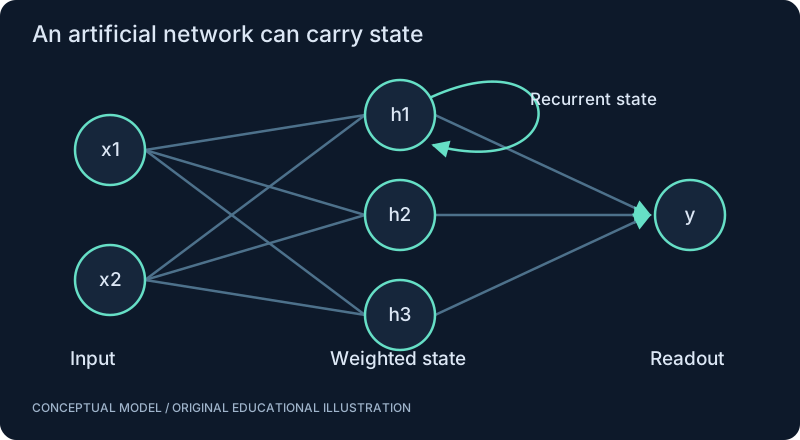
Memory can mean temporary task state, stored facts, an episode, a learned association or a changed synapse. These functions operate on different timescales and should not be collapsed into one mechanism. A system that retrieves a document has a different operation from a recurrent circuit that maintains activity after a stimulus disappears.
Associations and attractors
An attractor model uses recurrent dynamics to move nearby states toward stable patterns under particular assumptions. Hopfield’s work is an influential artificial-network example. The score calculation below is simpler: it compares a partial cue with stored vectors once. It does not implement attractor dynamics, capacity analysis or a hippocampal model.
Neural-network perspective
Transformer context, recurrent state, retrieval systems and external databases provide different memory interfaces. Retrieval selects information; it does not verify that the information is true. A robust system tracks provenance, update time and uncertainty. Evaluate interference, false recall, outdated records and forgetting rather than measuring only successful retrieval from an easy example.
SEE THE RELATIONSHIPS
From structure to behavior.
MAKE THE IDEA PRECISE
The mathematics.
| Symbol | Meaning |
|---|---|
| cue | Query vector, with zero representing a missing component in this toy |
| pattern_j | Stored candidate vector j |
| score_j | Unnormalized dot-product similarity |
| i | Vector component index |
Build the equation, step by step
- For a cue and candidate of equal length, multiply corresponding entries and sum the products. This is a dot-product similarity, not a calibrated probability.
- With signed binary patterns, matching signs contribute positively and opposing signs contribute negatively.
- Rank the candidate scores. For general real vectors, vector length affects the result; normalization or a different distance may be needed. Retrieval is only one component of a memory system.
WORK THROUGH THE NUMBERS
Worked example
A partial cue [1, 0, 1] scores 2 against [1, -1, 1] and -2 against [-1, 1, -1]. The result identifies a closer pattern in this tiny constructed set, not a general memory capacity.
A small Python experiment.
Python 3 · Standard library only · Synthetic educational example. Run this in your own notebook or a local file.
cue = [1, 0, 1]
patterns = [[1,-1,1], [-1,1,-1]]
scores = [sum(a*b for a,b in zip(cue,p)) for p in patterns]
print(scores)
Expected output
[2, -2]
Change one quantity, predict the result, and then run the code again. Explain any difference before adding complexity.
Test your understanding.
Try it: Corrupt one nonzero cue component. Does the selected pattern remain reliable?
Self-check: Does selecting the most similar stored pattern prove that the answer is true?
No. Similarity retrieves candidates; it does not validate their content, origin or current relevance. Keep provenance and uncertainty, and check a retrieved claim against appropriate evidence before using it as a fact.
Where this model stops: Similarity does not establish truth, and biological memory categories are not one-to-one software modules.
A research question: How should a hybrid system resolve conflicting memories with different provenance?
Record evidence in your mastery worksheet →THE NEXT LAYER
Chapter depth map.
This introduction provides a first model. The following chapters are outlines for deeper future editions; their full treatments have not yet been published.
Biological categories and mechanisms
17.1 Timescales and memory functions · Outline
- 17.1.1 Working, short-term and long-term memory
- 17.1.2 Episodic, semantic and associative memory
- 17.1.3 Behavioral categories versus neural mechanisms
- 17.1.4 Synaptic plasticity and consolidation
- 17.1.5 Species differences and limits of analogy
17.2 Dynamical memory · Outline
- 17.2.1 Recurrent attractors and persistent state
- 17.2.2 Noise, capacity and interference
- 17.2.3 Hippocampal-inspired models
- 17.2.4 Recall cues and pattern completion
- 17.2.5 Test mechanisms with perturbations
Artificial memory systems
17.3 Context, retrieval and storage · Outline
- 17.3.1 Transformer context and its boundaries
- 17.3.2 RAG and vector retrieval
- 17.3.3 External memory and agent state
- 17.3.4 Provenance, update policies and forgetting
- 17.3.5 Retrieval is not evidence that a claim is correct
17.4 Hybrid memory experiments · Outline
- 17.4.1 Fast state plus slower durable representations
- 17.4.2 Consolidation schedules as hypotheses
- 17.4.3 Retrieval accuracy and temporal consistency
- 17.4.4 Adversarial or conflicting memories
- 17.4.5 Compare with simpler task-specific state
Read with the original sources.
These readings support the concepts and deeper investigation. The worked numbers and illustrations above are teaching examples.
Primary paper / author manuscript
Vaswani et al. (2017): Attention Is All You Need ↗
Read after matrix multiplication and optimization. Reconstruct query-key-value shapes and distinguish sequence modeling from embodied control.
Author-hosted textbook
Neuronal Dynamics — Gerstner, Kistler, Naud & Paninski (2014) ↗
Use for neuron-model prerequisites and notation; this site provides an original curriculum, not a reproduction of the textbook.
Primary paper
Hopfield (1982) — neural networks and collective computation ↗
A source for attractor-network memory; the simplified pattern example here is original and does not reproduce its experiments.